

Why Deepfake Detection Accuracy Is Dropping in 2026 — and What Platforms Must Do
A detector performs brilliantly in a test. Then a manipulated video reaches a live platform, passes through upload processing, and slips past the same detector.
For trust and safety teams, that gap is the problem. A benchmark measures performance on a particular collection of files. A platform receives blurry screenshots, compressed videos, edited images, short audio clips, and material made with techniques that may not have existed when the detector was trained. The two environments can produce very different results. In practice, deepfake detection work through AI-driven deepfake detection technology that analyzes subtle signals in synthetic media using computer vision and signal processing techniques.
The headline needs a qualification: research does not show that every deepfake detector is becoming less accurate. It shows that performance can fall sharply under specific conditions, especially when detectors encounter unfamiliar deepfakes or media that has been processed after creation, including cues not visible to the human eye, which is why automated detection systems are needed. One study evaluating face swaps collected from online platforms found that the tested detectors approached random guessing on its real-world dataset. Another found that a model trained on older examples suffered a recall drop of more than 30% when tested on deepfakes made with techniques from six months later. Those findings concern the models and test conditions in the studies; they are not a measured decline for every product.
So what should a platform do? Start by asking a better question than “How accurate is our detector?”
Ask: Which harmful uploads, including deepfake content, are we missing, under what conditions, and what happens when the system is unsure?
Why a strong benchmark score for deepfake detection tools can mislead
Deepfake detection tools and detection methods can overfit to the familiar generators, file formats, or processing patterns represented in a test dataset. That can make it highly effective on familiar examples. A detector may learn to recognize those cues the way machine learning models often absorb dataset-specific shortcuts rather than the manipulation itself. It says less about a newly generated face swap that has been cropped, sent through a messaging app, recorded from a screen, and uploaded again.
This is why a single accuracy figure rarely tells a moderation team enough. Platforms should compare multiple detection algorithms instead of relying on one score alone. Two kinds of error matter, and they have different consequences:
- Missed deepfakes: Manipulated content is treated as genuine or receives no review.
- False alarms: Genuine content is flagged as manipulated.
A platform needs to measure both. It should also measure them where decisions are actually made: at the threshold that determines whether content is published, labeled, held for review, or removed. A detector might rank suspicious uploads well overall yet still miss too many harmful cases at the threshold the platform can operationally support.
The mix of uploads matters, too. If genuine content greatly outnumbers deepfakes, even a modest false alarm rate can send a large number of legitimate posts into a review queue. A headline score cannot show that workload on its own.
New generation methods expose old blind spots
Deepfake detection is a moving target as deepfake technology keeps evolving. A model trained on last year’s examples may recognize the artifacts left by those generation methods. A newer method may leave different traces—or much fainter ones—from deepfake generation models.
Research on detection across dataset versions illustrates the risk. Models performed strongly when training and testing data came from matched versions, but performance fell when they were tested across versions containing different generation techniques. In the study, recall on newer deepfakes dropped by more than 30% for models trained on the older data.
For a platform, the response is regular testing against unseen methods. Keep recent, confirmed cases in a separate evaluation set. Record the manipulation type when it can be established. Include older techniques as well: newer deepfake generation techniques do not make old ones disappear from user uploads, and detection models should also be tested on unseen methods found in real world deepfakes.
Refreshing a model or its training data may help, but an update needs to earn its place in production. Test it against the current upload mix, including genuine content that has previously caused false alarms, since deep learning models built with neural networks can still drift as deepfake generation changes.
Ordinary upload processing can erase useful clues
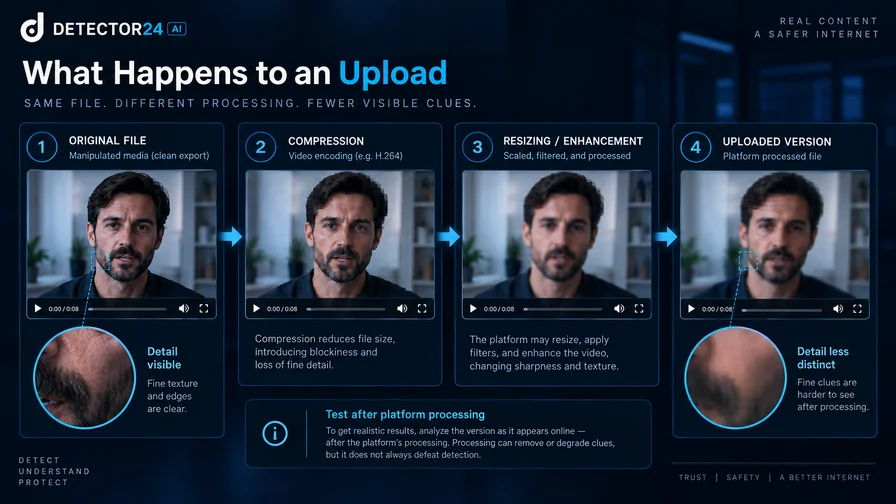
A deepfake does not have to be deliberately disguised to become harder to detect. Routine steps can change the evidence a detector sees, including through compression artifacts introduced during upload processing.
Platforms resize images to fit screens. Video services compress files. Users sharpen a photo, enhance a face, or save a screenshot of an earlier upload. A forged clip may pass through several of these steps before a moderation system analyzes it. Studies using real-world-style transformations have found significant performance losses after JPEG compression and image enhancement, and different quality levels affect how much useful evidence remains. Research involving face swaps collected from online platforms also identified super-resolution processing as a source of degradation for the detectors tested. The size of the effect varies by model and processing method, which is precisely why platforms should test their own upload pipeline.
A useful test starts with the same confirmed real and manipulated files. Evaluate them before upload, then use forensic analysis to evaluate the versions users or viewers actually encounter after resizing, compression, or other processing. If the results differ, the platform has found a measurable gap between lab performance and production conditions.
The cost of a mistake depends on real world scenarios
AI generated images, a fabricated public statement, and a non-consensual intimate image can all involve manipulated media. They do not call for identical moderation decisions.
Consider a scam profile. Missing a generated face may allow an account to build trust and target other users. These cases can enable identity fraud or identity theft. A false alarm, however, might block a legitimate person from joining. For a purported news clip, the urgency may come from how quickly a false claim can spread in misinformation campaigns, especially before news organizations can verify it. In a report of non-consensual intimate imagery, the risk of ongoing harm on social media may require prompt protective action while a trained reviewer investigates. Detector24 identifies fake profiles, impersonation, misinformation, and sexually explicit deepfakes among the platform use cases for its detection tools.
That is why one detection threshold should not automatically govern every case. Platforms can set review rules according to the potential harm, the available supporting evidence, and the cost of a wrong decision.
A detection result is one signal in that decision. A low score does not prove a clip is authentic. A high score does not prove that a particular person created it, intended to deceive, or violated a platform rule. Those conclusions require context.
Test the material users actually upload for detection accuracy
The most useful evaluation set resembles the platform’s own traffic, while containing enough confirmed cases to reveal where detection fails. Build it from several sources: verified reports, resolved appeals, reviewer findings, and carefully labeled test material, with synthetic media and authentic real videos included for comparison. Protect sensitive content and limit who can access it.
Then break results down. At a minimum, examine performance by:
- Media type: Images, deepfake video, and deepfake audio should be evaluated separately.
- Source and use case: Profile photos, direct messages, public posts, and reported content may have different patterns.
- Quality: Include low resolution files, short clips, poor lighting, and noisy audio.
- Processing history: Test originals, platform-processed uploads, screenshots, and reposted material.
- Manipulation method: Track newly observed methods separately where reliable labels are available (for example, face swap deepfakes or facial reenactment).
Where labels are dependable, track different manipulation techniques and synthetic manipulation patterns separately.
For each group, report missed deepfakes, false alarms, and the number of cases sent to human review. Compare those results over time using consistent definitions. When a new generator or upload pattern appears, add confirmed examples and check whether the existing threshold still works.
This turns “accuracy” into something a trust and safety team can act on. It might reveal, for example, that image detection remains stable while recall on heavily compressed video is falling because temporal artifacts or lip sync mismatches no longer hold up after poor uploads—or that a stricter threshold catches more impersonation attempts but overwhelms reviewers with genuine profile photos.
Give uncertain results a review path
A binary “real” or “fake” label makes moderation look simpler than it is. Some uploads contain too little usable evidence for a confident automated decision, especially when cues such as lip movements do not align with the audio. Others deserve closer attention because the potential harm is high.
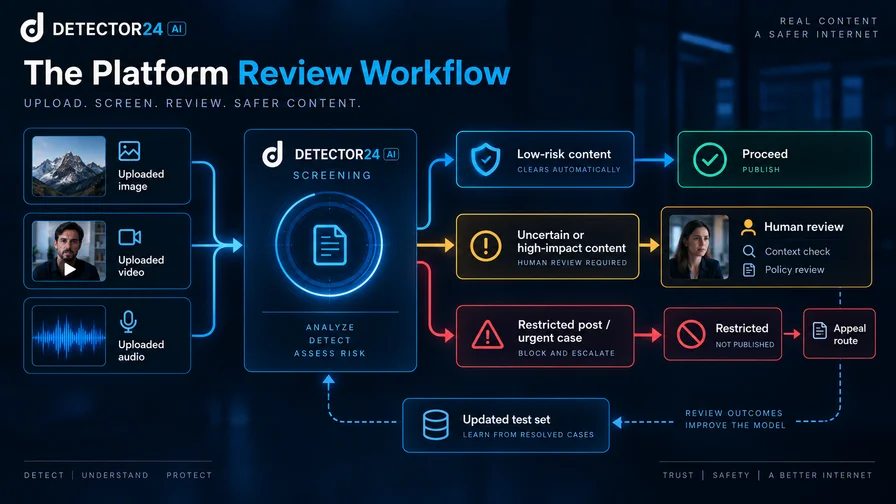
A practical workflow can route cases according to both the detection result and the surrounding risk. Low-risk uploads with no other concerning signals may proceed normally. Ambiguous cases can go to a reviewer, particularly when a user reports impersonation or supplies an original file for comparison, including in identity verification workflows. High-impact cases can receive faster review and appropriate temporary safeguards under the platform’s policies. Teams should also prioritize any deepfake scam report that appears to involve cloned voices.
Reviewers need more than a score. Give them the original upload when available, relevant processing details, the user report, and any context that can be examined without assuming the detector’s conclusion is correct, including content provenance when it is available. Record why a decision was made. If content is restricted or removed, provide a route for appeal so genuine material can be restored when the initial judgment was wrong.
Human review has limits of its own; a convincing fabrication can fool a person as well as a model. Its value lies in examining evidence and context that a detector score cannot settle.
Keep the system current after deployment
Deepfake detection is an ongoing measurement task for ai deepfake detection or synthetic media detection in production. A workable cycle is straightforward:
- Collect confirmed misses, false alarms, reviewer decisions, and appeal outcomes.
- Add representative cases to a protected test set, including ai generated content across images, video, and audio.
- Re-evaluate results by media type, quality, processing history, manipulation method, and real world scenarios.
- Reassess thresholds and review rules against the harms they are meant to address.
- Update the ai deepfake detector where testing shows an improvement, and compare detection systems after changes.
- Monitor outcomes after deployment for new gaps or unintended review volume.
Detector24’s image, video, and AI voice detection capabilities, alongside its content moderation tools, can be components of this workflow. A platform can use automated screening to identify material that needs attention, then apply its own review and appeal policies to consequential decisions. Effective deployment should help detect deepfakes in practical settings, but no single ai deepfake detector is definitive. Any accuracy claim should be read alongside the test set, media type, processing conditions, and decision threshold behind it.
The goal is not to find a score that ends the discussion. It is to build a system that notices when its evidence has become less reliable—and responds before the gap becomes a pattern of harm.
Want to learn more?
Explore our other articles and stay up to date with the latest in AI detection and content moderation.
Browse all articles