
Minor Detection
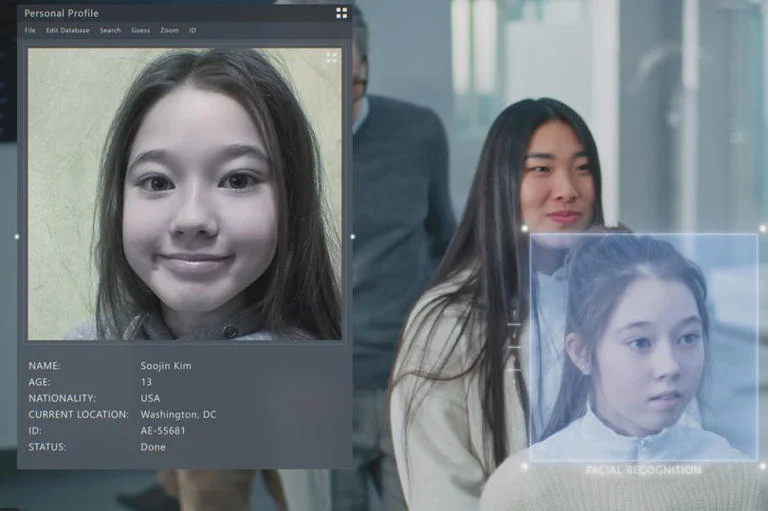
Detect minors and children in images with AI age estimation. Protect child safety, enforce age restrictions, and ensure platform compliance.
Bynn Minor Detection
The Bynn Minor Detection model identifies whether individuals in images are minors (under 18 years old). Trained on 2.5 million images from social media with a focus on teenage demographics, the model provides age estimation with sub-2-year accuracy for the critical 13-17 age range, enabling platforms to protect minors and comply with child safety regulations.
The Challenge
Child safety online has become a crisis. Social media platforms, gaming networks, and content sites host millions of minors who must be protected from adult content, predatory behavior, and inappropriate advertising. Yet platforms cannot reliably distinguish a 15-year-old from a 19-year-old based on self-reported birth dates that are trivially falsified.
Regulatory compliance demands accurate minor detection. COPPA in the US, GDPR in Europe, and similar laws worldwide impose strict requirements on how platforms handle data and content for users under 18. Failure to identify and protect minors results in devastating fines, legal liability, and public backlash. Manual review of millions of user profiles is impossible—automation is mandatory.
Age-restricted content proliferates across platforms. Alcohol advertising, gambling promotions, violent content, and adult material must not reach minors. Without accurate age detection, platforms either over-restrict content (frustrating adult users) or under-restrict (exposing children to harmful material). The 16-year-old who looks 20 and the 22-year-old who looks 16 both break the system.
Age verification gates fail without visual verification. Self-reported ages are lies. Credit card checks exclude millions of legitimate adults. The only reliable signal is the user's face—but that requires AI that can accurately estimate age, especially in the critical teenage years where appearance varies wildly and the difference between 17 and 18 determines legal compliance.
The teenage demographic is uniquely challenging. A 14-year-old and a 17-year-old may look identical or completely different depending on development. Lighting and camera angles all confound simple age estimation. Models trained primarily on adults fail catastrophically on teens—the very demographic platforms most need to protect.
Social media presents the hardest detection environment. Professional headshots are easy. Social media selfies are chaos—filters, poor lighting, awkward angles, occlusions, group photos. The model must work on real-world data, not curated datasets. Detection must be accurate across ethnicities, genders, and the infinite variety of how teens present themselves online.
Model Overview
The Bynn Minor Detection model analyzes facial features to estimate age and determine minor status. Achieving 91.3% accuracy with Mean Absolute Error under 2 years for ages 13-17, the model is specifically optimized for teenage age estimation—the most critical and challenging demographic for child protection.
The model processes multiple faces in a single image, providing individual age estimates and minor classification for each detected person.
How It Works
The model combines face detection with demographic estimation:
- Multi-face detection: Automatically detects and analyzes all faces in an image using advanced face detection
- Eye alignment: Normalizes face orientation for consistent analysis across varied poses and angles
- Age estimation: Predicts age with confidence intervals, optimized for accuracy on teenage faces
- Minor classification: Binary flag for under-18 status, plus Challenge 25 flag for under-25
- Uncertainty quantification: Provides age estimation uncertainty to identify low-confidence predictions
Response Structure
The API returns analysis for all detected faces:
- num_faces: Count of faces detected in the image
- faces: Array of face analysis results, each containing:
- age: Estimated age in years (e.g., 16.8)
- from_age, to_age: Age range bounds based on uncertainty
- is_minor: Boolean (true if age < 18)
- challenge_25: Boolean (true if age < 25, for Challenge 25 policies)
- sex: Estimated sex (male/female/unknown)
- sex_code: Numeric code (0=male, 1=female)
- bbox: Face bounding box coordinates {x1, y1, x2, y2}
- confidence: Face detection confidence (0.0-1.0)
- uncertainty: Age estimation uncertainty in years
- image_size: Original image dimensions {width, height}
Training Data
The model was trained on 2.5 million images from social media with emphasis on teenage demographics. This training approach ensures the model performs well on real-world social media selfies, group photos, and casual photography—not just professional headshots.
Performance Metrics
| Metric | Value |
|---|---|
| Detection Accuracy | 91.3% |
| Teen Age MAE (13-17) | < 2 years |
| Average Response Time | 110ms |
| Max File Size | 20MB |
| Supported Formats | GIF, JPEG, JPG, PNG, WebP |
| Training Dataset | 2.5M social media images |
Use Cases
- Social Media Age Gating: Enforce minimum age requirements for platform access and feature availability
- Content Filtering: Automatically restrict age-inappropriate content from reaching minors
- Advertising Compliance: Prevent alcohol, gambling, and adult product ads from displaying to minors
- Child Safety Monitoring: Flag minor presence in contexts that may indicate exploitation or inappropriate interactions
- Account Verification: Verify user age during registration to enforce COPPA and similar regulations
- Parental Controls: Enable age-based content filtering in family sharing and parental control systems
- Challenge 25 Enforcement: Support retail and service age verification policies
Known Limitations
Important Considerations:
- Appearance variability: Some teens look older, some young adults look younger—age estimation is probabilistic
- Facial structure analysis: Model analyzes underlying facial bone structure and aging patterns, not superficial appearance
- Image quality: Blurry, dark, or heavily filtered images reduce accuracy
- Ethnicity variations: Age perception differs across ethnic backgrounds; model trained on diverse dataset
- Occlusion effects: Masks, sunglasses, or partial face visibility impact estimation
- Boundary cases: The 17-18 boundary is challenging; use uncertainty scores for edge cases
- Face angle: Persons may be estimated older when not looking directly at the camera. Faces turned approximately 12 degrees or more from frontal view can affect age estimation accuracy, potentially causing younger individuals to appear older
Disclaimers
This model provides probability-based age estimation, not definitive age verification.
- Screening Tool: Use as an automated screening layer, not as sole evidence of age
- Uncertainty Handling: High uncertainty scores (> 3.0 years) indicate low-confidence predictions requiring additional verification
- Threshold Tuning: Adjust age boundaries based on risk tolerance—consider 16+ cutoff instead of 18+ for higher recall
- Combine Signals: Use alongside account history, behavioral signals, and other verification methods
- Appeal Process: Provide mechanisms for users incorrectly flagged as minors to verify their age
Best Practice: Deploy minor detection as part of a multi-signal age verification system. Combine with account age, declared age, behavior patterns, and optional ID verification for high-risk features. Use the uncertainty score to route borderline cases to manual review or additional verification steps.
Complete Age Verification Solution
This model provides age detection as an API endpoint. For a complete age verification solution with a full SDK for online content protection, regulatory compliance tools, and comprehensive age assurance features, see Bynn's Agemin product.
API Reference
Input Parameters
Estimates age and sex from facial images (handles multiple faces)
image_urlstringRequiredURL of image containing face(s) for demographic estimation
https://example.com/face.jpgResponse Fields
Demographic analysis for all detected faces
num_facesintegerNumber of faces detected in image
2facesarrayArray of face analysis results
agefloatEstimated age in years
25.3from_agefloatAge range lower bound
23to_agefloatAge range upper bound
27.5is_minorbooleanTrue if age < 18 (minor)
falsechallenge_25booleanTrue if age < 25 (Challenge 25 policy)
truesexstringEstimated sex
femalesex_codeintegerSex code (0=male, 1=female)
1confidencefloatDetection confidence
0.95uncertaintyfloatAge estimation uncertainty
1.2bboxobjectFace bounding box
{"x1":100,"y1":150,"x2":300,"y2":400}image_sizeobjectOriginal image dimensions
{
  "width": 1920,
  "height": 1080
}
Complete Example
Request
{
  "model": "minor-detection",
  "image_url": "https://example.com/face.jpg"
}
Response
{
  "success": true,
  "data": {
    "num_faces": 1,
    "faces": [
      {
        "age": 25.3,
        "from_age": 23,
        "to_age": 27.5,
        "is_minor": false,
        "challenge_25": true,
        "sex": "female",
        "sex_code": 1,
        "bbox": {
          "x1": 100,
          "y1": 150,
          "x2": 300,
          "y2": 400
        },
        "confidence": 0.95,
        "uncertainty": 1.2
      }
    ],
    "image_size": {
      "width": 1920,
      "height": 1080
    }
  }
}
Additional Information
429 HTTP error code along with an error message. You should then retry with an exponential back-off strategy, meaning that you should retry after 4 seconds, then 8 seconds, then 16 seconds, etc.Ready to get started?
Integrate Minor Detection into your application today with our easy-to-use API.