
Military Scenes Detector
Detect military content: weapons, vehicles, personnel, and combat scenes. Moderate sensitive imagery and enforce content policies on global platforms.
Bynn Military Scenes Detector
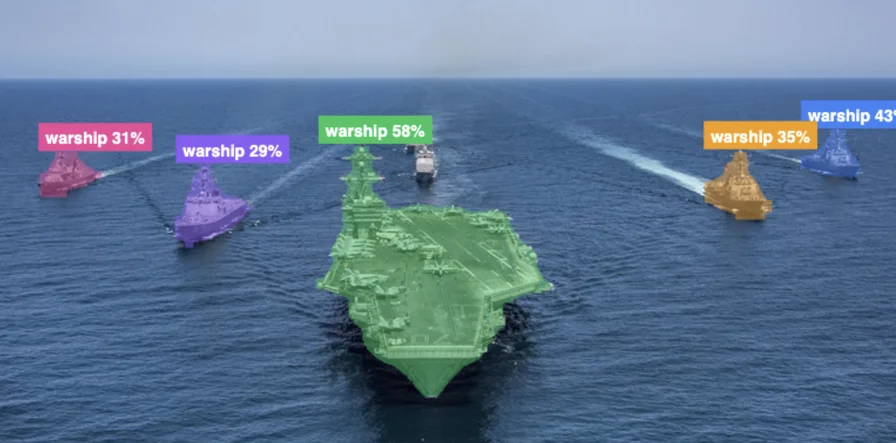
The Bynn Military Scenes Detector identifies and locates military-related content in images, including soldiers, military vehicles, aircraft, naval vessels, and combat equipment. This model is valuable for moderating sensitive content and classifying news imagery.
The Challenge
Military imagery carries heightened sensitivity across multiple dimensions. Conflict zone content can traumatize viewers, glorify violence, or spread propaganda. Images may reveal operational security details. In times of war, military content becomes a vector for misinformation and psychological operations targeting civilian populations.
Platforms must balance legitimate uses—journalism, historical documentation, defense industry content, veteran communities—against harmful applications. The context matters enormously: a tank in a museum differs from a tank in combat. News coverage of conflicts serves public interest; recruitment propaganda may not. Detection enables these nuanced moderation decisions.
For defense and security applications, military detection serves operational purposes. Drone reconnaissance can automatically identify enemy positions, vehicle concentrations, and troop movements. Defense industry workflows can classify and organize imagery for analysis. Border security systems can detect military vehicles or personnel in restricted zones. The same detection capability that moderates content can provide tactical awareness in the field.
Model Overview
When provided with an image, the detector analyzes the visual content to identify military personnel, equipment, and scenes. The model uses advanced object detection with instance segmentation, providing both the location of detected items and pixel-level masks that precisely outline each detection.
Achieving 94.9% accuracy, the model can detect a wide variety of military content including soldiers in uniform, tanks, fighter jets, warships, submarines, missiles, and other military equipment.
How It Works
The model employs open-vocabulary object detection technology, allowing it to recognize military-related items based on learned visual patterns. For each detected item, the system returns:
- Bounding box coordinates: The rectangular region containing the detected object
- Confidence score: A probability value (0.0-1.0) indicating detection certainty
- Class name: The specific type of military item detected
- Segmentation mask: A pixel-level PNG mask outlining the exact shape of the detected object
Response Structure
The API returns a structured response containing:
- num_detections: Total count of military-related items detected in the image
- detections: Array of detection objects, each containing:
- bbox: Bounding box coordinates {x1, y1, x2, y2}
- score: Detection confidence (0.0-1.0)
- class_name: Type of military item
- mask_png: Base64-encoded PNG segmentation mask
- image_size: Original image dimensions {width, height}
Detected Classes
The model can identify the following military-related items:
Ground Forces
- Tank, military vehicle
- Soldier, troop, military personnel
- Military uniform, camouflage
- Army, military, troops marching
Air Forces
- Helicopter
- Fighter jet
- Missile, rocket
Naval Forces
- Warship, aircraft carrier
- Submarine
Weapons & Equipment
- Rifle, gun
- Soldier with gun, armed soldier
Performance Metrics
| Metric | Value |
|---|---|
| Detection Accuracy | 94.9% |
| Average Response Time | 5000ms |
| Max File Size | 20MB |
| Supported Formats | GIF, JPEG, JPG, PNG, WebP |
Use Cases
- Sensitive Content Moderation: Flag military imagery for additional review in conflict-sensitive contexts
- News & Media Classification: Categorize news content containing military imagery
- Geopolitical Content Policies: Enforce platform policies around military and conflict-related content
- Brand Safety: Prevent brand advertisements from appearing alongside military or war-related content
- Content Classification: Tag military content for appropriate audience targeting
- Research & Analysis: Support open-source intelligence (OSINT) and media analysis workflows
Known Limitations
Important Considerations:
- Civilian vs. Military: Some civilian aircraft, ships, or vehicles may resemble military equipment
- Historical Content: Historical military imagery, museum exhibits, or war memorials may be detected
- Gaming & Entertainment: Video game screenshots, movies, or airshows may be flagged
- Context Limitations: The model cannot determine the nature of conflict or political affiliation
- Partial Visibility: Heavily obscured military equipment may have lower detection confidence
Disclaimers
This model provides probability scores, not definitive identification or threat assessment.
- Screening Tool: Use as part of a broader content moderation strategy, not as the sole decision factor
- Neutral Detection: The model detects military content without political or geopolitical bias
- Human Review: Military content often requires contextual understanding; human review is recommended
- Not Intelligence: This tool is not designed for intelligence or military applications
Best Practice: Combine detection results with human review and contextual analysis, especially for news and geopolitically sensitive content.
API Reference
Input Parameters
Open-vocabulary object detection with segmentation. Detects objects using text prompts.
image_urlstringRequiredURL of the image for object detection
https://example.com/image.jpgResponse Fields
Object detection results with bounding boxes and segmentation masks
num_detectionsintegerNumber of objects detected
3detectionsarrayArray of detected objects
bboxobjectBounding box {x1, y1, x2, y2}
{"x1":100,"y1":150,"x2":300,"y2":400}scorefloatDetection confidence (0.0-1.0)
0.95class_idintegerClass index
0class_namestringDetected object class name
personmask_pngstringBase64-encoded PNG segmentation mask
data:image/png;base64,...image_sizeobjectOriginal image dimensions
{
  "width": 1920,
  "height": 1080
}
Complete Example
Request
{
  "model": "military-detection",
  "image_url": "https://example.com/image.jpg"
}
Response
{
  "success": true,
  "data": {
    "num_detections": 2,
    "detections": [
      {
        "bbox": {
          "x1": 100,
          "y1": 150,
          "x2": 300,
          "y2": 400
        },
        "score": 0.95,
        "class_id": 0,
        "class_name": "person",
        "mask_png": "data:image/png;base64,iVBORw0KGgo..."
      },
      {
        "bbox": {
          "x1": 400,
          "y1": 200,
          "x2": 600,
          "y2": 450
        },
        "score": 0.87,
        "class_id": 1,
        "class_name": "car",
        "mask_png": "data:image/png;base64,iVBORw0KGgo..."
      }
    ],
    "image_size": {
      "width": 1920,
      "height": 1080
    }
  }
}
Additional Information
429 HTTP error code along with an error message. You should then retry with an exponential back-off strategy, meaning that you should retry after 4 seconds, then 8 seconds, then 16 seconds, etc.Ready to get started?
Integrate Military Scenes Detector into your application today with our easy-to-use API.