
Destruction & Fire Detector
Detect fire, explosions, building damage, and destruction in images. Monitor insurance claims, news content, and safety incidents automatically.
Bynn Destruction & Fire Detector
The Bynn Destruction & Fire Detector identifies and locates scenes of destruction, fire, and damage in images, including building damage, vehicle accidents, fires, explosions, and disaster scenes. This model is essential for moderating disaster content and supporting insurance claims processing.
The Challenge
Images of destruction and disaster present unique moderation challenges. Graphic fire and accident imagery can traumatize viewers, particularly during ongoing emergencies when victims and families may encounter content depicting their losses. Yet this same imagery serves critical purposes—news reporting, insurance documentation, emergency response coordination.
The volume of disaster imagery has exploded with smartphone ubiquity. Every accident, fire, and emergency generates dozens of images shared across platforms. Moderators need to identify this content for appropriate handling—content warnings, restricted distribution, or expedited processing for insurance claims. Automated detection enables rapid response at scale impossible for human review alone.
Beyond content moderation, destruction and fire detection enables critical operational applications. CCTV systems can detect accidents and fires in real-time, triggering emergency response before human operators notice. Drone surveillance of forests can identify wildfires at their earliest stages when containment is still possible. Post-conflict drone reconnaissance can systematically map destroyed buildings for reconstruction planning, damage assessment, and humanitarian response coordination.
Model Overview
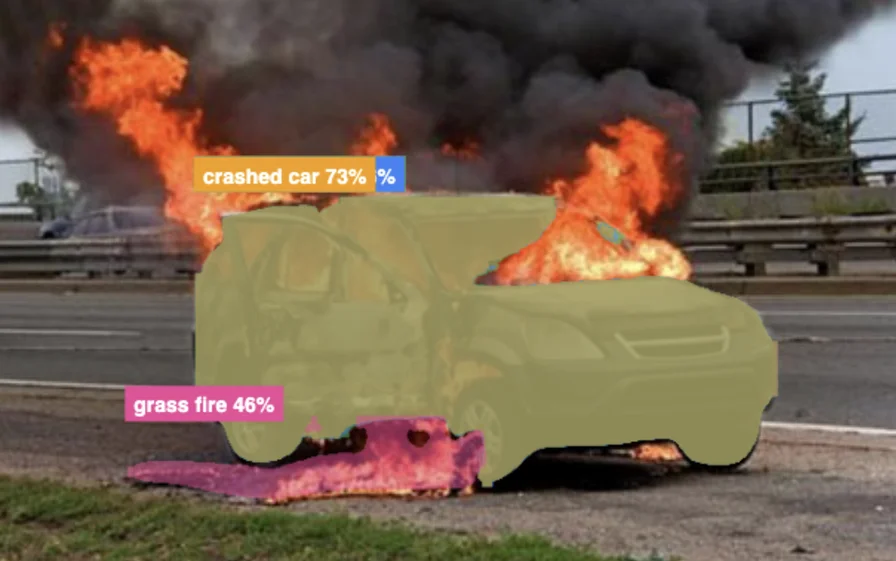
When provided with an image, the detector analyzes the visual content to identify destruction, fire, and damage. The model uses advanced object detection with instance segmentation, providing both the location of detected items and pixel-level masks that precisely outline each detection.
Achieving 92.6% accuracy, the model can detect a wide variety of destruction-related content including fires, explosions, building damage (from minor to complete destruction), vehicle accidents, wildfires, and civil unrest scenes.
How It Works
The model employs open-vocabulary object detection technology, allowing it to recognize destruction and fire-related elements based on learned visual patterns. For each detected item, the system returns:
- Bounding box coordinates: The rectangular region containing the detected object
- Confidence score: A probability value (0.0-1.0) indicating detection certainty
- Class name: The specific type of destruction or fire detected
- Segmentation mask: A pixel-level PNG mask outlining the exact shape of the detected area
Response Structure
The API returns a structured response containing:
- num_detections: Total count of destruction/fire elements detected in the image
- detections: Array of detection objects, each containing:
- bbox: Bounding box coordinates {x1, y1, x2, y2}
- score: Detection confidence (0.0-1.0)
- class_name: Type of destruction or fire
- mask_png: Base64-encoded PNG segmentation mask
- image_size: Original image dimensions {width, height}
Detected Classes
The model can identify the following destruction and fire-related elements:
General Fire & Destruction
- Fire, flame, smoke, inferno
- Explosion, blast, bomb
- Debris, rubble, wreckage, destruction, ruin
Building Damage
- Major damage: Destroyed building, collapsed building, bombed building, war damaged building, building rubble, demolished building, ruined building, building missing walls, building missing roof
- Minor damage: Broken windows, damaged building, vandalized building, damaged interior
- On fire: Building on fire, burning building, house on fire, apartment on fire, burning house
- Burned: Burned building, burned house, charred building, fire damaged building, burned down building
Vehicle Damage
- Major damage: Car crash, vehicle accident, wrecked car, destroyed vehicle, totaled car, crashed car, damaged vehicle, car wreck
- Minor damage: Minor car accident, dented car, car damage
- On fire: Car on fire, burning car, vehicle on fire, burning vehicle, truck on fire
- Burned: Burned car, burned vehicle, charred car, burned out car, burned down vehicle
Wildfires & Natural Disasters
- Wildfire, forest fire, brush fire, grass fire
Civil Unrest
- Violent protest, riot, civil unrest, street violence, burning barricade
Emergency Response
- Firefighter, fireman
Other
- Self-immolation, burning object
Performance Metrics
| Metric | Value |
|---|---|
| Detection Accuracy | 92.6% |
| Average Response Time | 5000ms |
| Max File Size | 20MB |
| Supported Formats | GIF, JPEG, JPG, PNG, WebP |
Use Cases
- Sensitive Content Moderation: Flag disturbing destruction imagery for appropriate content warnings or restrictions
- News & Media Classification: Categorize breaking news imagery involving fires, accidents, or disasters
- Insurance Claims: Process vehicle accident and property damage claims with automated image analysis
- Disaster Response: Support emergency response workflows by identifying imagery showing active fires or destruction
- Brand Safety: Prevent brand advertisements from appearing alongside disturbing disaster content
- Social Media Moderation: Detect and appropriately handle user-generated disaster and accident content
Known Limitations
Important Considerations:
- Controlled Fires: Campfires, fireplaces, candles, or controlled burns may be detected
- Cinematic Content: Movie explosions, video game screenshots, or special effects may be flagged
- Historical Imagery: Historical photos of disasters or war may be detected
- Severity Assessment: The model cannot assess the severity or recency of damage
- Context Limitations: The model cannot determine cause, intent, or whether emergency services have responded
Disclaimers
This model provides probability scores, not definitive assessment of damage or emergency status.
- Screening Tool: Use as part of a broader content moderation or claims processing strategy
- Not Emergency Detection: This tool is not designed for real-time emergency detection or response
- Human Review: Destruction and fire content often requires contextual understanding; human review is recommended
- Insurance Use: For claims processing, combine with professional assessment and verification
Best Practice: Combine detection results with human review and appropriate professional assessment for optimal outcomes.
API Reference
Input Parameters
Open-vocabulary object detection with segmentation. Detects objects using text prompts.
image_urlstringRequiredURL of the image for object detection
https://example.com/image.jpgResponse Fields
Object detection results with bounding boxes and segmentation masks
num_detectionsintegerNumber of objects detected
3detectionsarrayArray of detected objects
bboxobjectBounding box {x1, y1, x2, y2}
{"x1":100,"y1":150,"x2":300,"y2":400}scorefloatDetection confidence (0.0-1.0)
0.95class_idintegerClass index
0class_namestringDetected object class name
personmask_pngstringBase64-encoded PNG segmentation mask
data:image/png;base64,...image_sizeobjectOriginal image dimensions
{
  "width": 1920,
  "height": 1080
}
Complete Example
Request
{
  "model": "destruction-fire-detection",
  "image_url": "https://example.com/image.jpg"
}
Response
{
  "success": true,
  "data": {
    "num_detections": 2,
    "detections": [
      {
        "bbox": {
          "x1": 100,
          "y1": 150,
          "x2": 300,
          "y2": 400
        },
        "score": 0.95,
        "class_id": 0,
        "class_name": "person",
        "mask_png": "data:image/png;base64,iVBORw0KGgo..."
      },
      {
        "bbox": {
          "x1": 400,
          "y1": 200,
          "x2": 600,
          "y2": 450
        },
        "score": 0.87,
        "class_id": 1,
        "class_name": "car",
        "mask_png": "data:image/png;base64,iVBORw0KGgo..."
      }
    ],
    "image_size": {
      "width": 1920,
      "height": 1080
    }
  }
}
Additional Information
429 HTTP error code along with an error message. You should then retry with an exponential back-off strategy, meaning that you should retry after 4 seconds, then 8 seconds, then 16 seconds, etc.Ready to get started?
Integrate Destruction & Fire Detector into your application today with our easy-to-use API.