
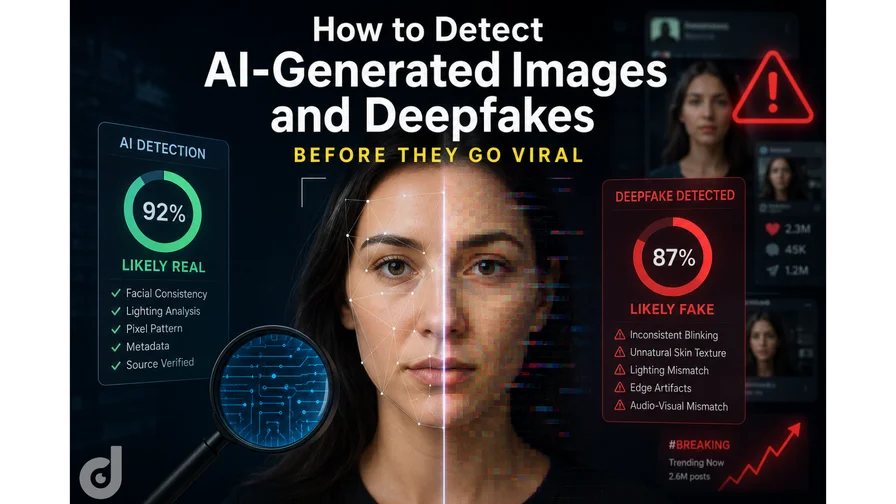
AI Image Detection: How to Detect AI-Generated Images and Deepfakes Before They Go Viral
AI-generated visuals are no longer fringe internet curiosities. Midjourney now openly describes itself as building image and video models, OpenAI says DALL·E 3 is available to ChatGPT users and API developers, Black Forest Labs markets FLUX.2 as a production-grade image generation and editing model, and the Stable Diffusion repository describes the model as a latent text-to-image diffusion system that can both generate and modify images. At the same time, NIST says creating deepfakes is now a low-cost, low-effort process, and the UK government has framed deepfake detection as a growing part of the online trust-and-safety ecosystem.
That combination matters because synthetic media is no longer just about memes or creative experimentation. The same underlying capabilities are now showing up in misinformation, impersonation, scam advertising, fake evidence, and platform abuse. The FBI has warned that attackers are using AI-generated voice messages to impersonate senior U.S. officials, Reuters reported on celebrity deepfake scam ads in Brazil, and the Bank of Italy publicly warned about fabricated articles, images, and videos falsely showing its governor endorsing investments. In other words: this is now a mainstream operational risk, not a niche media-literacy problem.
Why this became a mainstream trust problem
The reason synthetic media feels suddenly unavoidable is simple: the tooling got better, cheaper, faster, and more accessible all at once. NIST’s 2026 deepfake challenge page says a photograph harvested from social media can now be transformed into a hyper-realistic deepfake in seconds, while the UK government says harmful deepfakes are becoming cheaper to produce and require little to no technical expertise. That is exactly the kind of threshold shift that turns a specialist threat into an internet-scale one.
And the harms are broad. The UK government’s 2026 deepfake detection report says organizations are adopting detection across fraud prevention, brand protection, identity verification, misinformation response, and content moderation. It also highlights risks in social platforms, media, public safety, secure communications, and law enforcement. That is a useful framing: synthetic media is now best understood as a cross-functional risk touching trust, safety, security, compliance, and reputation at the same time.
You can already see the pattern in public examples. Reuters documented fabricated political imagery being mistaken for real election content in the UK, AI-generated crowd imagery miscaptioned as a real anti-immigration march in London, fake disaster photos of Disney World during Hurricane Milton, and AI-generated wildfire footage falsely passed off as authentic video from Israel. These are different topics, different audiences, and different emotional triggers, but they all exploit the same gap between seeing and verifying.
What counts as AI-generated media
Not every suspicious image falls into the same bucket, and that distinction matters. TikTok’s policy defines AI-generated content broadly as images, video, or audio that is generated or modified by AI, including realistic altered depictions of people, scenes, and events. Its examples include a real person whose words or appearance are altered, a real-world scene modified by AI, and entirely AI-generated depictions of real or fictional people, places, and events.
YouTube’s disclosure rules add another important nuance: some edits are minor or non-deceptive, while others are materially misleading. The platform says realistic face swaps, fabricated scenes of real events, cloned voices that mimic someone else, or realistic depictions of arrests, disasters, and public figures require disclosure. By contrast, color correction, lighting filters, sharpening, upscaling, repair, captioning, and other minor production assistance do not. That distinction is the practical one readers need: AI-generated is not automatically malicious, but realistic synthetic media presented as reality is where the trust-and-safety problem begins.
Technically, a lot of this visual content is now produced with diffusion models. A recent survey explains that diffusion models learn to reverse a process of adding noise so they can synthesize images, and describes them as the leading approach in text-to-image generation. The Stable Diffusion repository likewise describes the model as a latent text-to-image diffusion system, while also documenting image-to-image modification workflows built on diffusion-denoising. OpenAI’s DALL·E 3 page emphasizes stronger prompt adherence, which helps explain why modern synthetic images can look coherent enough to fool casual viewers even when they are entirely fabricated.
Why fake visuals spread before people verify them
False content does not win online because it is true. It wins because it is fast, emotional, and frictionless to share. MIT researchers found that false news spreads significantly farther, faster, deeper, and more broadly than true news on Twitter, that falsehoods are 70% more likely to be retweeted, and that false stories reached 1,500 people about six times faster than true ones. They also found that people reacted to falsehoods with surprise, fear, and disgust—exactly the emotional profile that feeds impulsive resharing.
That is the mechanics of synthetic virality. A fake image does not need to persuade everyone. It only needs to trigger enough early outrage, fear, amusement, or tribal affirmation to force itself into recommendation loops, group chats, reposts, and screenshots before anyone checks the source. In practice, the damaging moment is often the first engagement cycle, not the later correction. MIT’s findings on speed and emotion line up with Reuters case studies where synthetic media collected hundreds of thousands or even millions of views before debunks caught up.
The examples are instructive. Reuters reported that an AI-generated image miscaptioned as a London immigration rally racked up 2.3 million views on X, a fake Green Party candidate image drew more than 300,000 views, and the AI-generated Disney flood images reached nearly half a million views across platforms. In fraud contexts, Reuters reported that scammers used deepfakes of Gisele Bündchen and other celebrities in Instagram ads, while the Bank of Italy warned that fabricated investment promotions using its governor’s likeness were circulating widely enough to warrant a legal complaint. Fast reach is what turns fabrication into harm.
What to look for in suspicious images and deepfakes
The old stereotype was “count the fingers.” That still helps sometimes, but it is no longer enough. The Guardian’s practical guide points to surplus or malformed limbs, blurred or nonsensical text, mismatched symmetry, broken textures, impossible geometry, and scene inconsistency as common visual clues. The UK House of Commons Library offers a similar checklist: wrong numbers of fingers or teeth, distorted background faces, strange patterns, text that does not correspond to any language, and lighting, reflections, or perspective that seem to defy physics.
The more forensic view is subtler: detectors and forensic methods analyze visual patterns and structures to judge whether an image was made by AI image generators or altered, rather than relying on watermarks or metadata. Hany Farid’s Content Authenticity Initiative essay points to shadows, reflections, vanishing points, environmental lighting, and eye-region cues as useful indicators because these checks can reveal subtle artifacts and inconsistencies that help separate real photos from AI-generated or manipulated images, even when the overall image looks polished. Reuters’ Disney World fact check gives a good real-world example: experts flagged warped castle structures, inconsistent reflections, missing windows, and unsupported artifacts—the same kind of analysis an ai art detector or other specialized system uses to flag generator outputs. Those are not just “weird details”; they are signs that the scene does not obey the same rules a real camera scene would.
But visual inspection is only half the job. The House of Commons Library recommends verifying the original source, running a reverse image search, comparing the claim against other imagery from the same place and time, and checking whether the supposed origin predates the event in question. That is critical because some synthetic images are posted first as jokes, art, or demonstrations and only later recirculated as “real.” A reverse image search that finds no trustworthy provenance is not proof of fakery, but it is a meaningful warning sign.
There is also an uncomfortable truth here: many of yesterday’s best tells are fading. GIJN’s 2025 reporting guide notes that hands, teeth, and text used to be strong indicators, but says major models improved sharply by 2025, making those older clues much less reliable on their own. That means the right mindset is no longer “spot one flaw and declare victory.” It is closer to probabilistic triage: combine source checks, context checks, physical consistency checks, and machine analysis before you trust the image.
Why human moderation alone breaks down
Humans are not as good at this as we like to think. A 2024 systematic review and meta-analysis covering 56 papers and more than 86,000 participants found that overall deepfake detection performance was not significantly above chance; image deepfake accuracy averaged about 53%, and video about 57%. The same paper found that detection-improvement strategies—feedback training, AI support, and other interventions—can raise performance, but the baseline finding is blunt: unaided human judgment is shaky. By contrast, research from the University of Rochester and the University of Kansas using 80,000 images found that an ai image detector achieved higher accuracy than human performance.
That leaves traditional moderation in a bad position. Manual review is slow, platform volume is huge, and the signals are moving targets. Hany Farid warns that nearly all forensic techniques have a limited shelf life because generative systems keep improving. The UK government’s deepfake detection market report adds that limited representative training data, concerns over reliable detection, and the challenge of handling high volumes in real time remain key barriers, with false positives and false negatives remaining practical errors. So even when moderation teams know what they are looking for, the environment keeps mutating beneath them.
There is another problem too: the “liar’s dividend.” Chesney and Citron introduced the idea that as the public becomes more aware of deepfakes, bad actors can use that awareness to dismiss genuine evidence as fake. The Brennan Center’s 2024 analysis makes the point clearly: heightened awareness of synthetic media can incentivize public figures to lie about authentic content, and deepfake detectors alone are not a silver bullet. Detector outputs should support human judgment rather than replace it when assessing image authenticity. That means moderation has to solve for both sides of the crisis: fake content being treated as real, and real content being waved away as AI-generated.
Platform policy changes tell the same story. Meta says its original manipulated-media policy was too narrow because it focused on a world where realistic AI-generated content was rare and primarily video-based; it later expanded into broader labeling across images, audio, and video. YouTube now requires disclosure for realistic altered or synthetic content, and TikTok requires labeling for realistic AI-generated content while also using C2PA-based content credentials for some auto-labeling. Those shifts are a tacit admission that older moderation models were designed for a simpler problem than the one platforms now face.
How AI-powered detection changes the workflow
This is why AI now has to fight AI. Modern detectors do not rely on one clue; they stack signals. Detector24’s public AI Image Detection page says its system analyzes pixel-level texture, noise, and pixel-distribution patterns, generates confidence scores, and performs forensic analysis without depending on metadata or visible watermarks. In other words, it works as an ai image checker, or image detector, that inspects the media itself and can review an image file in common formats without relying on whatever provenance data survived upload and repost chains.
That technical approach matches the direction of current research. Frequency-based methods like FreqNet focus on amplitude and phase information in the frequency domain to improve generalization across unseen generators. Fingerprint-oriented work such as Deep Image Fingerprint shows that synthetic-image detectors can learn model-specific traces and even support model-lineage analysis. More recent multimodal surveys argue that robust detection is shifting from single-modal image analysis toward systems that fuse image, video, audio, and text signals because newer deepfakes are increasingly cross-modal and context-aware. For video, some real-time approaches also analyze gaze and blink anomalies as physiological cues.
Operationally, that means organizations should stop treating detection as a last-step fact-check and start treating it as infrastructure. For online platforms, the right pattern is upload-time or near-real-time scanning, confidence thresholds, policy-aware routing, and fast escalation for high-risk content, including review of uploaded images and user uploaded images across social media posts, e commerce listings, and legal evidence workflows. Detector24’s moderation pages say teams can set custom confidence thresholds and moderation rules, while the UK government’s report stresses that automated detection is crucial for social platforms managing harmful content at scale. Reactive review alone is simply too slow once synthetic content begins to snowball.
For journalists and verification teams, the workflow should be “source first, detector second, publication last.” Teams can use an image checker to check images in news articles and other media verification workflows. The House of Commons Library recommends locating the original source and comparing against other imagery from the same event, while the Brennan Center argues media outlets should prepare in advance for claims that compromising content is AI-generated and should invest in provenance-aware workflows. The useful role of AI detection here is not to replace editorial judgment. It is to narrow the queue, highlight suspect media early, and give human reviewers stronger evidence faster.
For businesses, the priorities are slightly different but the logic is the same: catch impersonation before conversion, catch scam ads before spend, catch synthetic evidence before payout, and catch manipulated onboarding media before account creation. Reuters’ reporting on celebrity deepfake ads, the FBI’s warning about AI impersonation, and the UK report’s emphasis on fraud prevention all point in the same direction. Where identity onboarding or KYC/KYB/AML controls are involved, synthetic-media checks should complement—not replace—identity verification layers. An ai tool can analyze IDs and selfies for signs of tampering or synthetic imagery, helping detect fake identity documents and strengthen KYC identity verification during onboarding. In e commerce, authenticating product images helps verify authenticity, reduce misleading content, and maintain trust.
Where Detector24.ai fits and what comes next
Positioned correctly, Detector24.ai is not just an “AI detector.” It is a real-time trust-and-safety layer for suspicious media and an ai detector image tool offered as an ai image detector online. Its public documentation describes dozens of moderation models, with the API docs referencing 60+ models across image, video, audio, and text. Its model catalog includes AI-generated image detection, image deepfake detection, and a separate model for locating AI-edited regions with bounding boxes; it also functions as an ai photo detector and ai picture detector for identifying ai created or edited visuals, which matters because many risky assets are no longer fully synthetic—they are surgically edited. Detector24 also exposes API-based integration, confidence scoring, and threshold-based workflow control, which is exactly what moderation teams need when they want to triage first and review second.
That matters most in the first hours of spread. If suspicious media can be analyzed in real time, assigned a confidence score, and returned as a detection result with a detailed report for reviewers, the blast radius changes. Detector24’s image-detection page describes sub-second image analysis, support for bulk screening, and API integration into content pipelines; its broader product pages also describe deepfake-video detection and real-time moderation scenarios. For trust-and-safety teams, that means less blind manual review, fewer “after the fact” cleanups, and a better shot at stopping harm before virality hardens into public belief.
E-commerce platforms are also increasingly using these systems to verify product images in listings, reducing misleading AI-generated or manipulated visuals and helping maintain consumer trust.
Looking ahead, detection alone will not be enough. C2PA describes Content Credentials as an open standard for establishing the origin and edits of digital content, and NIST’s synthetic-content report explicitly treats provenance, watermarking, labeling, and detection as complementary approaches. The Brennan Center likewise argues that proving content authentic may be more promising than only trying to prove content fake, but warns adoption across the media chain remains the hard part. The future is therefore not “AI detector or provenance standard.” It is both, plus platform policy, faster workflows, and better public verification habits, with art detector workflows also supporting proper attribution and transparency around AI-generated artworks.
The broader arc is an AI-vs-AI arms race, and the credible side has to move faster. NIST is still running adversarial deepfake evaluations, and the UK is building a framework to test tools against real-world threats such as impersonation, fraud, and abuse. That is the right direction. Automated trust infrastructure has to keep evolving because the generators absolutely will. The platforms, newsrooms, and businesses that adapt first will not eliminate synthetic deception—but they will be far better at stopping it before it goes viral.
Open questions and limitations
No detector is a magic wand. NIST, the UK government, and the Brennan Center all emphasize that real-world reliability, generalization to new manipulation techniques, and adoption of provenance standards remain unresolved challenges. That means any deployment—including Detector24.ai—should be tested on your own content mix, upload pipeline, compression path, image quality, and escalation rules rather than treated as universally perfect out of the box.
One final caution: some of Detector24’s public performance claims are vendor-published, while the wider research consensus still says detection is a moving target. Expect occasional false calls, and use any ai photo checker for reliable image verification as part of a layered review process rather than as a standalone verdict. The strongest strategy is therefore layered: forensic detection, provenance checks, source validation, policy-aware moderation, and human review for the hardest calls. That is not overkill anymore. It is what modern digital trust looks like.
Want to learn more?
Explore our other articles and stay up to date with the latest in AI detection and content moderation.
Browse all articles