
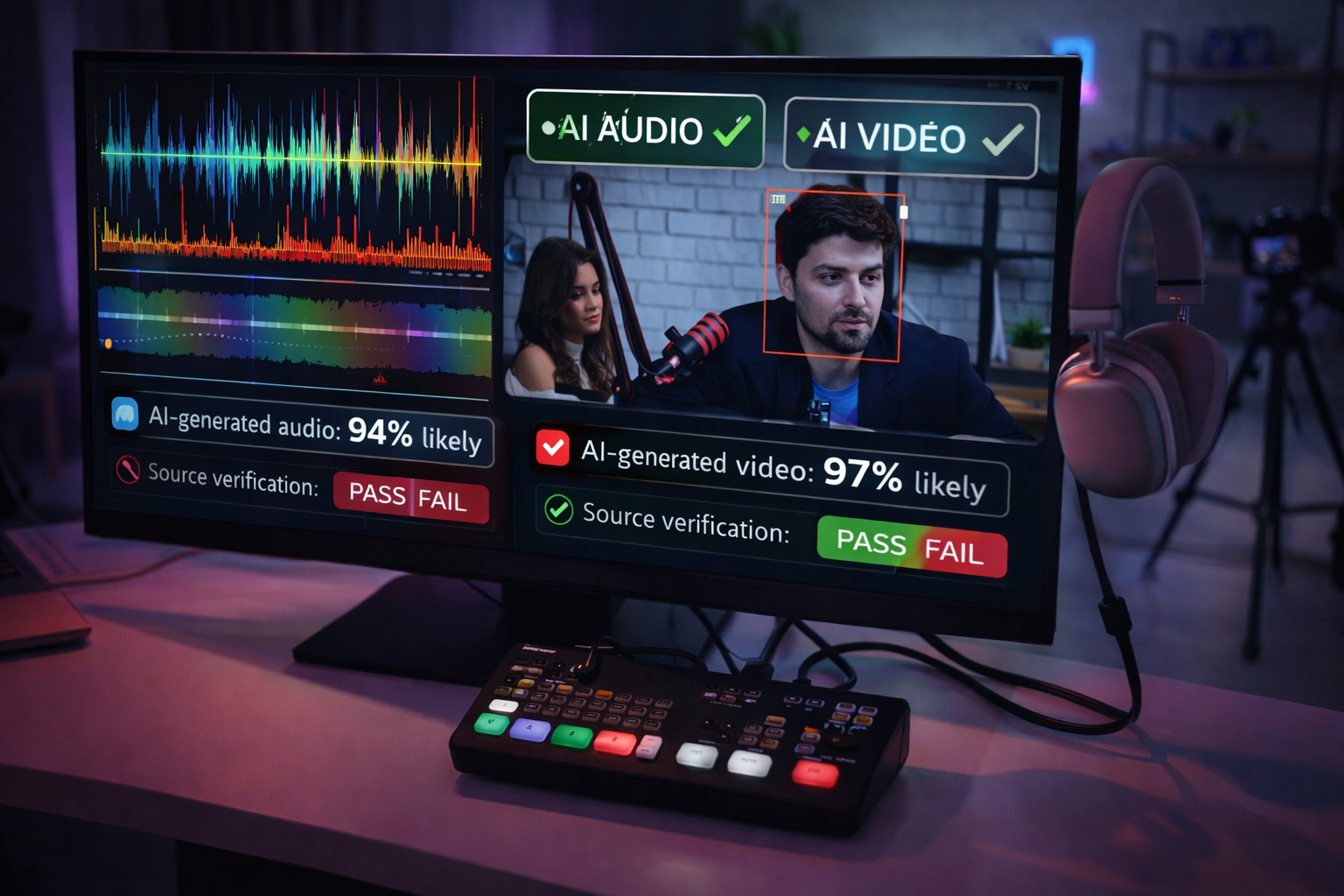
AI Content Moderation (Audio & Video) with Detector24 Models
Online communities don’t just “post” anymore—they broadcast. Livestreams, voice rooms, video calls, short-form clips, podcasts, reaction content, and remixes move at a pace that makes purely manual review impossible. That’s why AI Content Moderation has become a core part of modern Trust & Safety operations: it helps moderators triage risk, respond faster, and keep platforms compliant—especially when content is high-volume, high-velocity, and multimodal.
Detector24’s AI Moderation Model Catalogue provides 37+ AI-powered moderation models spanning image, video, audio, and text, with dedicated options for audio + video review. In this article, we’ll focus on the models that matter most for audio and video moderation workflows, and show how moderators can operationalize them in real-world queues.
Why audio & video are the hardest surfaces to moderate
Text is fast to scan and cheap to store. Images are static. But audio and video moderation is a different class of problem:
- Time-based evidence: A single violation may occur for 2 seconds in a 3-hour stream.
- Context shifts: A scene can go from harmless to disallowed instantly.
- Multi-signal reasoning: Risk might be in the visual, the audio, or the interaction between both (e.g., benign visuals + abusive speech).
- Latency pressure: Livestreams and real-time calls require sub-second detection to prevent exposure.
- Adversarial behavior: Deepfakes, voice clones, and edited clips are engineered to “look real.”
This is exactly where AI Content Moderation delivers outsized value: it can run continuously, consistently, and at scale—then route the truly ambiguous cases to human judgment.
Detector24’s AI Content Moderation model catalogue: what moderators should know
Detector24 organizes its catalogue across modalities, including Video and Audio that directly support moderation of streams, uploads, and voice-based experiences.
From an operations perspective, the catalogue metadata is especially useful because it includes:
- Accuracy (how reliable the model is under its evaluation setup)
- Speed/latency (how quickly a check returns)
- Starting price (helpful for forecasting at scale)
Quick reference: Detector24 audio + video moderation models
Below is a moderator-friendly snapshot of the audio and video models shown in Detector24’s catalogue.
Video models (5)
Video Deepfake Detection — detect deepfakes/face manipulations
Accuracy: 99.9% | Speed: 8000ms | Starting at: $0.0150
Face Liveness Detection — anti-spoofing for biometric authentication
Accuracy: 98.2% | Speed: 2100ms | Starting at: $0.0240
Wanted Persons Detection — real-time face recognition in videos against law enforcement databases
Accuracy: 97.5% | Speed: 5000ms | Starting at: $0.2500
Violence Detection (video) — detect violence levels in video
Accuracy: 91% | Speed: 10000ms | Starting at: $0.0300
Content Rating (video) — rate content as PG / PG-13 / R
Accuracy: 92% | Speed: 20000ms | Starting at: $0.0300
Audio models (3)
AI-Generated Music Detection — detect if music is AI-generated
Accuracy: 89.5% | Speed: 2200ms | Starting at: $0.0150
Voice Deepfake Detection — detect AI-generated or cloned voices
Accuracy: 87.4% | Speed: 2400ms | Starting at: $0.0150
Voice Safety Detection — detect unsafe audio (harassment, profanity, discrimination, illegal content)
Accuracy: 86.5% | Speed: 2500ms | Starting at: $0.0150
Video AI Content Moderation with Detector24: how each model fits a real queue
1) Video Deepfake Detection: authenticity enforcement at scale
Deepfakes are no longer niche. They show up in impersonation, fraud, harassment, misinformation, and reputation attacks. Detector24’s Video Deepfake Detection model is built to detect deepfakes and face manipulations, with catalogue-listed 99.9% accuracy.
Where it helps moderators
- Pre-upload holds: block or hold suspicious uploads before recommendation.
- High-risk routing: send high-confidence matches to a specialized “authenticity” queue.
- Escalation packaging: attach the deepfake score (and any available metadata) to reviewer tools so the moderator doesn’t start from zero.
Operational tip: In most platforms, the deepfake decision isn’t binary—moderators often need to decide between labeling, downranking, holding, removal, or account enforcement. Deepfake scoring is valuable precisely because it enables graduated responses.
2) Face Liveness Detection: stopping spoofing before it hits moderation
While commonly used for verification, Face Liveness Detection also supports moderation by preventing policy evasion and fraud patterns that generate downstream abuse (fake accounts, repeat offenders, ban evasion). Detector24 lists this model as anti-spoofing for biometric authentication, with 98.2% accuracy.
Where it helps moderators
- Account integrity workflows: reduce fake/bot-driven content creation.
- Appeals & re-verification: apply liveness as part of “prove it’s you” enforcement steps.
- High-risk segments: marketplaces, dating, financial communities, or any area where identity abuse drives harm.
3) Wanted Persons Detection: specialized high-stakes screening
Detector24’s catalogue includes Wanted Persons Detection for videos, described as real-time face recognition against databases including Interpol, Europol, the FBI, and additional law enforcement databases.
Because this capability has significant privacy, policy, and legal implications, it typically belongs in high-governance deployments:
- strict access controls
- defined legal basis and documentation
- audit trails and review requirements
- clear remediation and appeal pathways
Moderator takeaway: Treat outputs here as screening signals, not final truth. This is the type of model where your SOP should specify what moderators can do (and cannot do) with a match, who gets notified, and how evidence is preserved.
4) Violence Detection: risk scoring for fast-moving video
Violence is one of the most operationally expensive categories in Trust & Safety—especially in livestreams where exposure happens in real time. Detector24’s Violence Detection (video) model detects violence levels, listed at 91% accuracy in the catalogue.
How it helps moderators
- Live incident triage: route violent moments to “urgent” reviewers.
- Severity-based decisions: differentiate “fight in a game stream” vs. real-world graphic violence.
- Automation guardrails: if your policy allows it, auto-interrupt only on high-confidence, high-severity thresholds.
5) Content Rating: policy alignment via classification (PG / PG-13 / R)
Not all unsafe content is removable—some is “allowed with restrictions.” Detector24’s Content Rating (video) model classifies videos into PG, PG-13, or R based on nudity, violence, and language, with 92% accuracy listed.
Why moderators care
- Supports age-gating and content warnings
- Helps reduce “all-or-nothing” enforcement
- Gives moderators a structured starting point for borderline cases
Audio AI Content Moderation with Detector24: three models that cover authenticity + safety
1) Voice Safety Detection: moderating speech in real time
For voice rooms, calls, livestream commentary, and voice notes, Voice Safety Detection targets unsafe audio including harassment, profanity, discrimination, and illegal content.
Where it fits
- Real-time voice channels: rapid triage and auto-mute or warn flows
- Voice notes: pre-send or post-send review
- Multi-language communities: combine model output with policy expertise to handle nuance
2) Voice Deepfake Detection: stopping synthetic impersonation
Voice clones are increasingly used for fraud, impersonation, and manipulation. Detector24’s Voice Deepfake Detection identifies AI-generated/cloned voices.
A key operational advantage: Detector24’s voice detection approach is designed around segment-based analysis. The AI Voice Detection product description explains that longer recordings can be split into short segments (around 6 seconds) with Voice Activity Detection (VAD) to skip silence, producing time-stamped results.
Moderator benefit: Time-stamped segmentation means reviewers can jump directly to suspicious moments instead of listening to entire files.
3) AI-Generated Music Detection: authenticity for music-heavy platforms
Detector24’s catalogue includes AI-Generated Music Detection, intended to identify whether music is AI-generated.
Detector24’s AI Music Detector product description also highlights a model-agnostic approach (not relying on watermarks) and a probability score output for classification, supporting scalable content tagging and policy enforcement.
Where it fits
- UGC platforms with music uploads/remixes
- Rights management workflows (labeling and routing, not legal adjudication)
- Trust labeling (“AI-generated” transparency)
- Reducing spam/low-quality synthetic uploads that overwhelm queues
Turning models into a moderation system: recommended routing patterns
Models don’t replace moderators—they make moderation scalable. Here’s a practical way to design routing that keeps humans in control.
Pattern A: Two-tier triage (fast lanes + expert lanes)
Autoflag lane (high confidence):
- Immediately action only when the model score is extremely high and your policy is clear.
Expert review lane (medium confidence / high risk):
- Deepfake claims, identity signals, violent incidents, ambiguous speech.
Pass lane (low confidence):
- Content flows with logging for later audit sampling.
This structure reduces queue noise while keeping accountability where it belongs—on human judgment for edge cases.
Pattern B: Live streaming “sliding window” moderation
Detector24’s video moderation solution emphasizes frame-by-frame analysis, configurable sampling, and real-time stream moderation. In practice, moderators can use a sliding window workflow:
- Segment stream into short windows (e.g., 2–10s)
Run:
- Violence detection for immediate risk
- Content rating for age gating decisions (often better offline, but still useful)
- Deepfake detection for authenticity incidents
- Voice safety detection on the audio track for harassment incidents
- Escalate alerts with timestamps and model confidence
Pattern C: “Policy bundles” for consistent enforcement
Bundle models by policy goal:
- Authenticity bundle: Video Deepfake + Voice Deepfake + AI Music Detection
- Safety bundle: Violence Detection + Voice Safety Detection
- Trust/Integrity bundle: Face Liveness Detection (and governance-controlled specialized screening where applicable)
Bundling reduces tool sprawl and keeps enforcement consistent.
Calibration tips: making AI Content Moderation outputs usable for humans
Even high-accuracy models need calibration to your platform’s norms.
- Start with conservative automation. Use AI to route before you use it to remove.
- Track “override rates.” If humans frequently reverse model-driven flags, adjust thresholds or add context rules.
Use confidence bands, not single cutoffs.
- e.g., >0.95 = auto action, 0.70–0.95 = human review, <0.70 = log + sample
- Audit by category and by locale. Audio especially can vary by accent, slang, and cultural context.
- Document everything. For appeals and regulatory readiness, save model outputs, timestamps, and final human decisions.
Detector24’s moderation positioning explicitly supports hybrid workflows: AI for speed + human oversight for nuance and accountability.
FAQ: AI Content Moderation (Audio & Video) with Detector24
What is AI Content Moderation in audio and video?
AI Content Moderation uses machine learning models to detect policy violations and authenticity risks in time-based media—such as unsafe speech, violence, and synthetic manipulation—so moderators can respond faster and more consistently. Detector24 supports audio and video screening with specialized models in its catalogue.
Which Detector24 models are most useful for voice rooms and calls?
For voice-heavy surfaces, moderators typically rely on Voice Safety Detection (unsafe speech) and Voice Deepfake Detection (synthetic/cloned voices).
How can moderators review long audio faster?
Detector24’s voice detection approach can segment longer recordings (around 6 seconds per chunk) and provide time-stamped results, helping moderators jump to the relevant segments quickly.
What video models help with livestream safety?
Detector24’s video models include Violence Detection (video) for safety risk scoring and Content Rating (video) for age gating decisions, alongside deepfake and liveness capabilities.
Do Detector24’s models support real-time workflows?
Detector24’s video moderation offering emphasizes real-time, frame-by-frame analysis with configurable sampling and stream moderation capabilities.
Closing: build safer audio & video experiences with Detector24
If your moderation team is battling livestream incidents, voice harassment, synthetic impersonation, or AI-generated media floods, AI Content Moderation is the only sustainable way to keep up—without burning out human reviewers.
Detector24 gives you a practical toolkit: catalogue-listed audio and video models for deepfake detection, voice safety, content rating, and liveness—plus a broader platform built for real-time and batch moderation.
Next step: Explore Detector24’s Model Catalogue and map the audio/video models to your policy bundles (authenticity, safety, integrity), then tune routing thresholds around your moderators—not the other way around.
Want to learn more?
Explore our other articles and stay up to date with the latest in AI detection and content moderation.
Browse all articles